
‘Our key aspiration is to feed our people’
‘Our key aspiration is to feed our people’

We will like to ask you to state the real character of the company, who you are, what your intentions are, what is the business all about?
Elephant Group started business 18 years back, precisely 1994. We started in the Agro business; agro exports. Those days, there were a lot of incentives for exporters to have foreign exchange, and as such we saw the opportunity in this sector and we began to create agro commodities for cocoa and cashew and began to process them across the world because there was a gap in funding of foreign exchange by the government and Central Bank then.
So just after we started a couple of years after, we got involved in other sectors of the economy like the oil services such as power and energy and then on to the agro industry and we found out there was a huge gap in the production and distribution of agro products to the population.
So we sat down and thought that we needed to play big in this area. Because of this, we’ve been strong players in the areas of rice which is a major staple food in the country and agro input with all sorts of fertilizers and we’ve been one of the critical players in this business.
That’s a summary of what we’ve been up to. Primarily our focus has been more on the agricultural industry in the economy.
The agro allied sector is one of the most vibrant sectors of the economy today, especially with regards to the Minister of Agriculture Akinwunmi Adesina who is championing a transformation of the sector. So I ask you, how have you keyed into this transformation agenda?
Talking about agro allied, we have actually analyzed the policy of the current government in terms of developing and transforming the economy in the agricultural sector. The government has good intentions.
I believe that contrary to the situation we had hitherto, we are definitely going to have a positive impact henceforth. However, talking about our own personal input to this sector, we have improved and increased our contributions both practically and financially into the sector.
We have increased the size of our production and supplies into the system, we have realized the increased demand that is going to arise from the increased activity in the agricultural sector with the programs of the government; that is, increasing cultivation and also making agriculture a business. That has been the focal point of the program of the ministry of agriculture.
Agriculture has to be a business and the farmers have to get compensation for doing so. The program the government has in place for it is the Growth Enhancement Support (GES) program and it has actually taken off fully focusing mainly on the provision of fertilizer and seedlings at reduced rate to beneficial farmers.
I believe this has thus far been a very innovative program. We are active players in the process, we are one of the few companies that supply fertilizer under the GES program and our product is all over the federation.
Can you talk about your products generally, some of those products you have in the market now?
We are looking at it from a two-point perspective. We are an agro input company as well as into fertilizers. Yet we need sectors developed to attack the problem of lack of food in the country and because of that we are committed to establishing a fertilizer plant and even producing the major input such as urea in Nigeria.
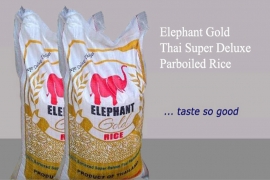
Additionally, we have the right products- we have Elephant Gold and Elephant Tomato, Thai super parboiled rice and so on. All of them are a success and market leaders in Nigeria.
Also, we are supporting government’s new innovation and the campaign of the transformation of the agricultural sector.
What we have done as a company is that we have established agro offices across the nation and this has solidified the agro economy. We go to the local government, the senatorial district, go to the farmers, know what their problems are and support them in the areas of input and the specific application of inputs to their areas.
In the area of production, what we’ve done is that we have sectionalized all the regions in the federation producing urea and we put together the cooperatives in those places that encourage, motivate and support the farmers to come together to increase their production in their farm.
What do we do for them? We support them with inputs, clearing the farm using tractors; we are moving them from subsistence levels to commercial farms. Some of the questions they ask us are; what is the guarantee that our production will be increased? Well, what we have done as a company that is a major player in the industry is to guarantee that their products succeed beyond the subsistence level.
We are partners with the government and we know that within 5 to 8 years, the story of Nigeria’s importing of some of these products must have changed if the government is consistent with their policy.
How do you get your funding? considering that many agricultural companies in Nigeria complain that banks do not want to lend to them. How much of your funding comes from banks? And how much of it is from retained earnings?
First, there has been an agric fund. For most of the people in production, a lot of it has been accessed. Like we said when we started this engagement, the company has been around for two decades and like you expect, a company that has been around for twenty years will have sufficient turnover to support itself. We have a lot of support from both local banks and international banks. I will not want to agree that banks don’t support agro business and I will tell you why. First of all, it is mandatory, if you look at the CBN rules, there is a percentage of the total lending that must go to agriculture. Secondly, it is rewarding, rewarding in the sense that the earnings from agro business is decent and consistent.
We have the population to support the activities desired of companies in this sector. What we have done is take advantage of all of this and increase our expertise in the agro products that we deal with.
What are your key aspirations?
Our key aspirations are to feed our people and every year we increase the number of people we engage in employment here. And as a company we want to increase our employment numbers and that gives us a lot of joy when we are able to support the government in taking people out of the street especially serious-minded, disciplined people.
We also want to ensure that our products are available in all parts of Nigeria and Africa as a whole and we consistently have been doing this. As a company, we also ensure that the quality of our products rival the best you can get anywhere. We want farmers to come back, we want traders to come back and tell us that oh this is what we bought from you and it gave us increased output – all this will give us a lot of joy.
Can you take us to the issue of partnerships if you have one?
Talking about partnerships, we have quite a proportion of partnerships – both locally and internationally. Locally, our partnerships spread right from the level of the farmer who goes to the trader, who distributes at the local government level, at the village level and up to the local government setup itself. After the local government and the state ministry, then the commissioner of Agriculture in all the farming encouraging states.
We build with them one on one and we cooperate together – these are some of our partnership programs. Equally at the federal ministry of Agriculture level, we communicate directly with the minister (Akinwunmi Adesina).
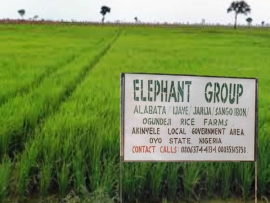
Our partnership with the rice farmers is to encourage them to cultivate as much rice as possible. Our plan is to set up rice-processing machines and it will be put in the production centers for the final finishing.
We also have partnerships in the former Soviet Union such as Ukraine and Romania.
So you’ll say that we have grown from a totally import company to a producing company. Also, some of our trade partners are going to be stakeholders in the factories that we are establishing here in Nigeria – trade partners, financial partners, technical advisers and these are international companies. By any standard, if you rate them, they are first, second, third in the world.
What’s the volume in terms of production and quantity of the fertilizer plant you plan to establish?
In terms of quantity, for instance, Nigeria consumes up to 2 – 3 million tons of fertilizer every year. Therefore, the blending plant is going to be about 250,000 metric tons per annum. Why we have to set up the blending plants is to ensure that we support crop production in every region of the country.
I don’t think many people have heard much about Elephant group, even though you seem to play in very strategic sectors of the economy, why is that?
We found out that it was better for us to work than to make noise. We believe that before we come out on the air to say we are doing this or that, you should go and check our production yourself to see that we’re doing much more than we talk about. There’s a lot more integrity in that. Our focus has been let our job talk for us. I believe we are very well known in our sector, including the ministry and government parastatals.
What wealth of experience can we find in your management team?
Thank you very much, like I said, Elephant Group is a company that has spanned up to 20 years. Our executive management is 18 years and we have people that come from different backgrounds who have spent many years in Agro business. Apart from that, we also have financial advisors who are very experienced.
Elephant Group is a wholly Nigerian group of companies dealing in Commodities Export and Import of equipments for Upstream Oil Industries, Import, Distribution and Marketing of Fertilizers, Wheat and Rice. The group also has a presence in Ghana, Cameroon and Niger. In this extensive interview, Elephant groups Managing Director Tunji Owoeye, tells Business day’s PATRICK ATUANYA and CHIAKA OSUALA that Elephant group is already keying into the nations agricultural transformation agenda.
BusinessDay Newspaper: Thursday, 16 August 2012 00:00 PATRICK ATUANYA and CHIAKA OSUALA
Release Date:
Friday, April 11, 2014
In The News
-
 Thu, 10/30/2014
 -
 Fri, 07/18/2014
 -
Tue, 05/20/2014
-
Thu, 05/15/2014
-
Thu, 05/15/2014
-
 Thu, 05/15/2014
 -
Thu, 05/15/2014
-
 Fri, 04/11/2014
 -
 Fri, 04/11/2014
 -
 Sat, 08/04/2012


